 SEARCH
 UPLOAD
 ABOUT
ABOUT CONTACT
Search results
Namibian Wildlife Surveys archive
This archive of reports of wildlife surveys in Namibia aims to:
- provide easy public access to published information and statistics
- enable easy stakeholder access to recent and historical data on wildlife populations
- provide a comprehensive archive of wildlife survey reports in Namibia
Public access to information is a vital component of ensuring community engagement in prevalent issues. Wildlife surveys are critical to determine the health of wildlife populations and determine trends over time to guide conservation and management actions.
Wildlife surveys are done for different species using methods that are suited to counting them (e.g. by air or road) in their natural habitats. Such surveys need to be repeated over time to detect long-term trends and inform conservation managers. The Namibian government, non-governmental organisations and private reserves all conduct regular surveys covering different parts of Namibia and targeting different species. This archive will thus serve as a repository of our collective knowledge of the trends and status of a variety of species occurring throughout Namibia.
Explore your search results using the filter checkboxes, or amend your search or start a new search.
Determining wildlife numbers and their distribution patterns are an important and relevant factor for increasing scientific knowledge, to provide credible information for managerial decisions to conserve and protect biodiversity. This research was aimed at studying the distribution of wildlife species within the Fish River Canyon using different Geographical Information System (GIS) approaches and methods by analysing distribution patterns, slope and aspect analysis on which the animals were counted in, and favourable vegetation type from which different wildlife species were…
| Attachment | Size |
|---|---|
| Determining wildlife numbers in the Fish River Canyon Reserve.pdf | 745.6 KB |
Assessing the numbers and distribution of threatened species is a central challenge in conservation, often made difficult because the species of concern are rare and elusive. For some predators, this may be compounded by their being sparsely distributed over large areas. Such is the case with the cheetah Acinonyx jubatus. The IUCN Red List process solicits comments, is democratic, transparent, widely-used, and has recently assessed the species.
| Attachment | Size |
|---|---|
| The distribution and numbers of cheetah in southern Africa_2017.pdf | 6.63 MB |
This research project deploys satellite tracking collars on ungulates in the GSNL and monitors their movements as well as other environmental parameters. Its objective is to document movement corridors and identify impediments to migration routes for springbok, oryx and Hartmann’s mountain zebra. Stefanie Urban successfully completed her Bachelor of Natural Resources Management (Honours) project at NUST at the end of 2016. Her project report is available on request.
| Attachment | Size |
|---|---|
| Tracking ungulate movements.pdf | 2.23 MB |
Vultures provide essential ecological services, yet are amongst the world's most threatened species with populations having declined by more than 95% within ten years in some places. The biggest factor causing this decline is the use of poison, either intentionally or unintentionally. Other factors causing declines are collision with and electrocution by powerlines, illegal harvesting for traditional medicines, habitat loss and drowning in reservoirs.
| Attachment | Size |
|---|---|
| Status assessment of Namibias vultures.pdf | 1.52 MB |
Summary of game counts in Hardap Game Park, May 2017.
| Attachment | Size |
|---|---|
| Game counts in Hardap Game Park_May 2017.pdf | 1.04 MB |
Summary of 2017 game counts: Kavango east.
| Attachment | Size |
|---|---|
| 2017 game counts_Kavango east.pdf | 945.05 KB |
Summary of game counts in north-west Namibia: Regional Summary.
| Attachment | Size |
|---|---|
| Game counts in north_west Namibia_Regional Summary_June 2017.pdf | 1.01 MB |
Summary of game counts in north-central Namibia, July 2017.
| Attachment | Size |
|---|---|
| Game counts in north_central Namibia_July 2017.pdf | 1.13 MB |
Summary of game counts in north-west Namibia: Conservancies north of the veterinary fence, June 2017.
| Attachment | Size |
|---|---|
| Game counts in north_west Namibia_Conservancies north of the veterinary fence_June 2017.pdf | 909.79 KB |
Summary of game counts in north-west Namibia: Palmwag and Etendeka concessions, June 2017.
| Attachment | Size |
|---|---|
| Game counts in north_west Namibia_Palmwag and Etendeka concessions_June 2017.pdf | 938.7 KB |
Summary of game counts in north-west Namibia: Hobatere concessions area, June 2017.
| Attachment | Size |
|---|---|
| Game counts in north_west Namibia_Hobatere concessions area_June 2017.pdf | 1.06 MB |
Summary of game counts in southern Namibia, May 2017.
| Attachment | Size |
|---|---|
| Game counts in southern Namibia_May 2017.pdf | 997.6 KB |
Summary of game counts in east Zambezi, Dry season - Live sightings, 2017.
| Attachment | Size |
|---|---|
| Game counts in east Zambezi_Dry season_Live sightings_2017.pdf | 890.83 KB |
Summary of game counts in Bwabwata NP, Dry season - Live sightings, 2017.
| Attachment | Size |
|---|---|
| Game counts in Bwabwata NP_Dry season _Live sightings_2017.pdf | 1.01 MB |
Summary of North Central Game Count data up to 2017.
| Attachment | Size |
|---|---|
| North Central Game Count data up to 2017.xlsx | 143.47 KB |
| Attachment | Size |
|---|---|
| South Game Count data up to 2017.xlsx | 89.28 KB |
| Attachment | Size |
|---|---|
| North West Game Count data up to 2017.xlsx | 423.04 KB |
The Iona National Park covers about 15,200 km2 or 1.52 million hectares of Angola's Namibe Province in the south-western part of the country. It is the largest national park in Angola. It is bounded by the Atlantic Ocean to the west, an escarpment to the east that marks the beginning of the interior plateau, the Curoca River to the north, and the Cunene River to the south. It is about 200 kilometres south of the town of Namibe. Iona was proclaimed as a reserve in 1937 and upgraded to a national park in 1964.
This survey attempt to quantify the incidence of human-crocodile conflicts (as form of humanwildlife conflicts) in the three perennial rivers namely: Kunene River, Okavango River and the four Zambezi River channels. These are the three river systems in Namibia that are most affected by human-wildlife conflicts. The survey further examine the perspective of local people who use these rivers on HWC, by unpacking the root causes of conflicts and identifying methods to mitigate HWC in the future.
| Attachment | Size |
|---|---|
| Aerial count of the roan antelope and other wildlife species in Khaudum National Park_2016.pdf | 2.56 MB |
| Attachment | Size |
|---|---|
| Summary of the 2015 Winter Wetland Bird Counts in Namibia.pdf | 3.06 MB |
| Attachment | Size |
|---|---|
| Wetland bird counts in Namibia_a summary_2016.pdf | 8.86 MB |
The species accounts are very detailed, doubtlessly benefitting from Peter's intimate and long-term knowledge of Botswana's birds. The range maps give one an immediate indication of where the bird occurs and the breeding bars give one an idea of when to expect the bird and when it breeds. These will prove handy when identifying e.g. migratory birds. The excellent illustrations show the birds in their local race and where sexes and ages differ, these are also illustrated. Perhaps one shortcoming of the illustrations is, that diagnostic features e.g.
| Attachment | Size |
|---|---|
| Book Review_Birds of Botswana.pdf | 346.34 KB |
The Nile crocodile,Crocodylus niloticus, is found throughout sub-Saharan Africa, including Namibia, Botswana and Angola. The species was transferred from CITES Appendix I to Appendix II in 2004, although it is recognized as peripherally endangered in Namibia due to diminishing habitat availability primarily from human encroachment. In 2013, a species management plan was approved in Namibia to assess the management of the Namibian Nile crocodile populations. During 2012, an aerial survey was conducted to provide an estimate of Nile crocodile population numbers.
Summary of game counts in north-west Namibia: Regional Summary, June 2016.
| Attachment | Size |
|---|---|
| Game counts in north_west Namibia_Regional Summary_June 2016.pdf | 1.05 MB |
Summary of game counts in north-west Namibia, July 2016.
| Attachment | Size |
|---|---|
| Game counts in north_west Namibia_July 2016.pdf | 988.19 KB |
Summary of game counts in north-west Namibia: Conservancies north of the veterinary fence, June 2016.
| Attachment | Size |
|---|---|
| Game counts in north_west Namibia_Conservancies north of the veterinary fence_June 2016.pdf | 855.27 KB |
Summary of game counts in north-west Namibia: Conservancies south of the veterinary fence, June 2016.
| Attachment | Size |
|---|---|
| Game counts in north_west Namibia_Conservancies south of the veterinary fence_June 2016.pdf | 893.65 KB |
Summary of game counts in north-west Namibia: Palmwag and Etendeka concessions, June 2016.
| Attachment | Size |
|---|---|
| Game counts in north_west Namibia_Palmwag and Etendeka concessions_June 2016.pdf | 906.75 KB |
Summary of game counts in north-west Namibia: Hobatere concessions area, June 2016.
| Attachment | Size |
|---|---|
| Game counts in north_west Namibia_Hobatere concessions area_June 2016.pdf | 794.73 KB |
Summary of game counts in southern Namibia, May 2016.
| Attachment | Size |
|---|---|
| Game counts in southern Namibia_May 2016.pdf | 691.95 KB |
Summary of game counts in Hardap Game Park, May 2016.
| Attachment | Size |
|---|---|
| Game counts in Hardap Game Park_May 2016.pdf | 842.19 KB |
Summary of game counts in Bwabwata NP, Dry season - Live sightings, 2016.
| Attachment | Size |
|---|---|
| Game counts in Bwabwata NP_dry season_Live sightings_2016.pdf | 1.04 MB |
After the initial and in-depth assessment of the leopard population in the Okonjima Nature Reserve via the use of remote camera traps that provided a detailed insight of their demography as well as temporal and spatial distribution patterns, a long-term monitoring program has been introduced. This aims to observe and monitor fluctuations in the composition of the population, as well as shifts and overlaps of home ranges and territories.
| Attachment | Size |
|---|---|
| The assessment of leopard density and population size via a capture.pdf | 1.45 MB |
An aerial survey of elephants and other animals was conducted in North West Namibia from 16th September to 8 th October 2016. A total area of 63431km2 was sampled at an average intensity of 8.19% using both transects (at an average of 6.7% sample intensity) and block counts (9.88% sample intensity). Total counts were conducted additionally by flying 921.5km along six rivers.
| Attachment | Size |
|---|---|
| Aerial survey of elephants and other animals in north western Namibia.pdf | 8.93 MB |
| Attachment | Size |
|---|---|
| Gondwana Kalahari Park Game Count 2016.jpg | 5.56 MB |

| Attachment | Size |
|---|---|
| Gondwana Canyon Park Game Count 2016.jpg | 6.98 MB |

| Attachment | Size |
|---|---|
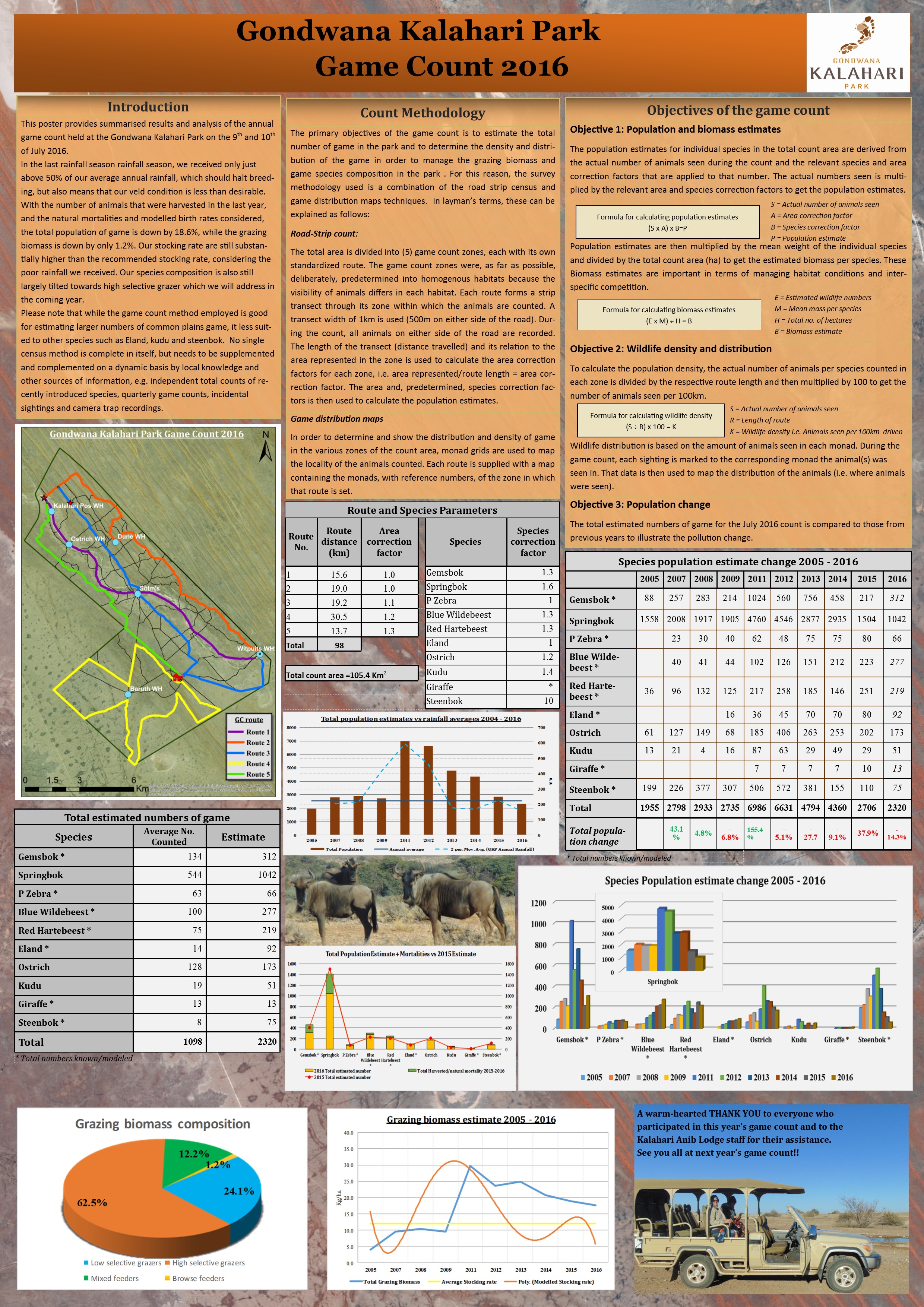
| Gondwana Kalahari Park game count 2016.jpg | 2.05 MB |
| Attachment | Size |
|---|---|
| GSNL wildlife monitoring Newsletter_2016.pdf | 2.92 MB |
Oryx 1770 and Zebra 1771 covered the most distance with 921.62 km and 877.36 km respectively (assuming a straight line between each ping). Mean daily distances have overall increased since the last period, possibly due to isolated rainfall during the period. Zebra 1773 has possibly been killed or the collar fell off, this is currently under investigation. Note: The mean daily distances in the last newsletter were not correct as they were distances between each ping. They should be multiplied by three to get the mean daily distance.
| Attachment | Size |
|---|---|
| GSNL wildlife monitoring Newsletter_2_2016.pdf | 1.94 MB |
Of the animals that had a comparable number of location pings, Oryx 1768 on Keerweder, Hartmann's zebra 1771 on Solitaire and Oryx 1770 on Aandster moved the furthest daily distances with 9.57 km, 7.87 km and 7.35 km respectively. Three animals were collared at the end of July/ beginning of August, including Springbok 132 (after the last one with the same collar id. died in March) and 133, Hartmann's zebra 1775 and 1776. Hartmann's zebra 1776, which is currently ranging on Neuras, moved a considerable mean daily distance of 9.22 km.
| Attachment | Size |
|---|---|
| GSNLNewsletter_1_3.pdf | 1.43 MB |
African elephants (Loxodonta africana) are imperiled by poaching and habitat loss. Despite global attention to the plight of elephants, their population sizes and trends are uncertain or unknown over much of Africa. To conserve this iconic species, conservationists need timely, accurate data on elephant populations. Here, we report the results of the Great Elephant Census (GEC), the first continent-wide, standardized survey of African savannah elephants. We also provide the first quantitative model of elephant population trends across Africa.
| Attachment | Size |
|---|---|
| Continent_wide survey reveals massive decline in African savannah elephants.pdf | 392.74 KB |
Caprivi is a key area for wildlife, which moves freely between Namibia and neighbouring countries. Caprivi has a number of community conservancy programmes, in addition to state protected areas. Conservancies have a strong commitment towards conservation, which contributes to rural livelihoods through the development of wildlife-based enterprises. A total of 19,212 head of wildlife (excluding birds) were observed. Information shown on this poster comes from the report: Fixed-wing aerial wildlife census of the Caprivi river systems. A survey of rivers, wetlands and…
| Attachment | Size |
|---|---|
| Wildlife census of Namibias North East rivers.pdf | 7.76 MB |
The 30 June 2008 signaled the end of the 2007 ringing season and the following is a summary thereof. In total 9 637 birds of 270 species were ringed or re-trapped, controlled etc. this season. Out of this total 9 033 were newly ringed birds (i.e. SAFRING code 1). Data from 19 ringers was received and Dirk Heinrich once again is the "ringing king" of code 1 birds, followed by Tim Osborne and Mark Boorman but in the re-trap etc. category Tim pipped Dirk, followed by Ursula Franke. Dirk also held top spot in the number of different species ringed category.
| Attachment | Size |
|---|---|
| Summary of the 2007 Ringing Season in Namibia.pdf | 239.46 KB |
The southern African Lesser Flamingo population was estimated to number 55,000 - 65,000 individuals in the mid-1990s, but these were either under estimates or the numbers have increased since, because at times Kamfers Dam, the Goldfields wetlands (in South Africa), Etosha Pan (Namibia) and Sua Pan (Botswana) each support more than that number. In order to try and get to grips with the size of the southern African population of Lesser Flamingos, a coordinated survey was planned for 20-21 July 2008.
| Attachment | Size |
|---|---|
| Population Census of Flamingos in Namibia July 2008.pdf | 316.42 KB |
| Attachment | Size |
|---|---|
| Narrative of Twenty_Five Days of Bird Counting in the Wild Hinterland of Namibia.pdf | 192.08 KB |
The start of the new year once again meant that Namibia's bird watchers had to dust off their binoculars and venture out to do the annual summer wetland counts. The global economic crisis does not seem to have affected the birders because I'm pleased to report that twenty-seven sites were counted although the geographic coverage is still very much biased in favour of the coast. The two Ramsar sites, Sandwich Harbour and Walvis Bay, once again came up trumps in terms of bird numbers but the most species were encountered by Wilferd at Oponono.
| Attachment | Size |
|---|---|
| Report on the Summer Wetland Bird Counts January_February 2009.pdf | 242.1 KB |
Poster summarising results of the Dry Season 2009 game counts in Bwabwata and Caprivi - numbers seen, population trends and estimates.
| Attachment | Size |
|---|---|
| Caprivi game count poster 2009.pdf | 244.86 KB |
Summary of game count in north west in 2009: route statistics, animals seen, population estimates, trends.
| Attachment | Size |
|---|---|
| NW game count poster 2009.pdf | 5.92 MB |
Poster summarising game count results for 5 conservancies in the south of Namibia in 2009, with trends for 2005 - 2009.
| Attachment | Size |
|---|---|
| South game count poster 2009.pdf | 1.42 MB |