 SEARCH
 UPLOAD
 ABOUT
ABOUT CONTACT
Search results
Namibian Wildlife Surveys archive
This archive of reports of wildlife surveys in Namibia aims to:
- provide easy public access to published information and statistics
- enable easy stakeholder access to recent and historical data on wildlife populations
- provide a comprehensive archive of wildlife survey reports in Namibia
Public access to information is a vital component of ensuring community engagement in prevalent issues. Wildlife surveys are critical to determine the health of wildlife populations and determine trends over time to guide conservation and management actions.
Wildlife surveys are done for different species using methods that are suited to counting them (e.g. by air or road) in their natural habitats. Such surveys need to be repeated over time to detect long-term trends and inform conservation managers. The Namibian government, non-governmental organisations and private reserves all conduct regular surveys covering different parts of Namibia and targeting different species. This archive will thus serve as a repository of our collective knowledge of the trends and status of a variety of species occurring throughout Namibia.
Explore your search results using the filter checkboxes, or amend your search or start a new search.
Accurately estimating hippopotamus (Hippopotamus amphibius) numbers is difficult due to their aggressive nature, amphibious lifestyle, and habit of diving and surfacing. Traditionally, hippos are counted using aerial surveys and land/boat surveys. We compared estimates of numbers of hippos in a lagoon in the Okavango Delta, counted from land to counts from video taken from a DJI Phantom 4TM drone, testing for effectiveness at three heights (40 m, 80 m, and 120 m) and four times of day (early morning, late morning, early afternoon, and late afternoon).
| Attachment | Size |
|---|---|
| Drone_based effective counting and ageing of hippopotamus in the Okavango Delta in Botswana.pdf | 893.17 KB |
| Attachment | Size |
|---|---|
| Zambezi Game Count_Bwabwata 2019.pdf | 748.18 KB |
| Attachment | Size |
|---|---|
| North West Game Count_North of Vet Fence 2019.pdf | 599.7 KB |
A boat survey conducted on 30 December 2017 along an 8.6 km stretch of the Okavango River revealed 45 adult Rock Pratincoles and 20 young birds. This brings the estimated number of Rock Pratincoles in the Okavango system in Namibia to about 361 birds, and for all river systems in Namibia to about 410 birds. Keywords: Glareola nuchalis, Namibia, Okavango river, Rock Pratincole, status.
| Attachment | Size |
|---|---|
| Status of the Rock Pratincole in the Kapako area of the Okavango River_2018_Brown.pdf | 1.03 MB |
| Attachment | Size |
|---|---|
| Game counts in north_west Namibia_ Regional Summary_2018.pdf | 1.12 MB |
| Attachment | Size |
|---|---|
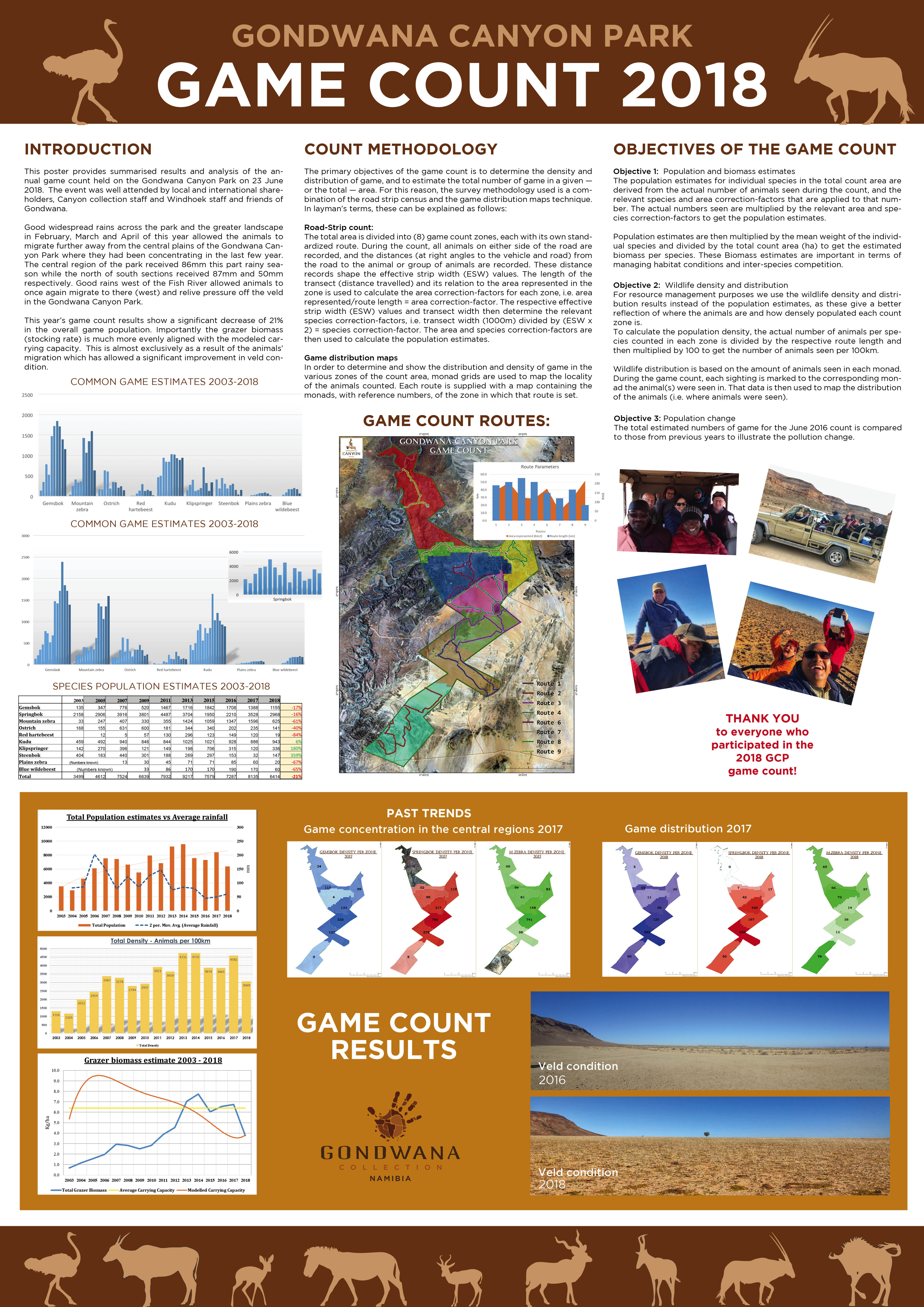
| Gondwana Canyon Park Game Count 2018.jpg | 3.01 MB |
| Attachment | Size |
|---|---|
| Game counts in southern Namibia_June 2018.pdf | 759.21 KB |
A total of 250,786 Cape Cormorants, of which 16,038 were individuals on nests in 349 colonies, and 15,831 Cape Fur Seals were counted during a complete aerial photographic census of the island of Tigres and part of the adjacent coast in Angola in March 2017. Such a concentration of birds and seals and the large number of breeding Cape Cormorants highlights the need to protect Tigres and its rich surrounding waters. Keywords: aerial census, Arctocephalus pusillus pusillus, Baía dos Tigres, Cape cormorant, Cape fur seal, Phalacrocorax capensis.
| Attachment | Size |
|---|---|
| Aerial census of Cape Cormorants and Cape Fur Seals at Baia dos Tigres.pdf | 3.54 MB |
| Attachment | Size |
|---|---|
| North West Game Count data 2018.xlsx | 434.86 KB |
Summary of game counts in north-central Namibia: Total Numbers of animals seen: last 5 years.
| Attachment | Size |
|---|---|
| Game counts in north_central Namibia_Total Numbers of animals seen_last 5 years_2018.pdf | 850.88 KB |
| Attachment | Size |
|---|---|
| Game counts in Hardap Game Park_July 2018.pdf | 772.41 KB |
Carnivore populations face threats from increasing human populations and rapidly diminishing, suitable habitat. Large carnivores such as African lions (Panthera leo) commonly attack livestock on lands adjacent to protected areas. This can lead to human-wildlife conflict (HWC) events that result in retaliatory lion killings. Conflict is a primary driver of wild lion population declines which are estimated to have decreased by 43% in the last 20 years.
| Attachment | Size |
|---|---|
| Etosha National Park Carnivore Monitoring Project_Lion GPS_Satelllite Monitoring.pdf | 2.09 MB |
| Attachment | Size |
|---|---|
| Game counts in north_west Namibia_Hobatere concession_June 2018.pdf | 581.38 KB |
| Attachment | Size |
|---|---|
| Game counts in north_west Namibia_Palmwag and Etendeka_June 2018.pdf | 662.25 KB |
Summary of game counts in north-west Namibia: Conservancies north of the veterinary fence, June 2018.
| Attachment | Size |
|---|---|
| Game counts in north_west Namibia_Conservancies north of the veterinary fence_June 2018.pdf | 622.61 KB |
| Attachment | Size |
|---|---|
| North Central Game Count data 2018.xlsx | 146.33 KB |
| Attachment | Size |
|---|---|
| Summary of the 2017 winter wetland bird counts in Namibia.pdf | 468.26 KB |
Summary of game counts in north-west Namibia: Conservancies north of the veterinary fence, June 2018.
| Attachment | Size |
|---|---|
| Game counts in north_west Namibia_Conservancies north of the veterinary fence_June 2018.pdf | 622.61 KB |
Carnivore populations face threats from increasing human populations and rapidly diminishing, suitable habitat. Large carnivores such as African lions (Panthera leo) commonly range outside of their protected areas and attack livestock on adjacent farmlands. This can lead to human-carnivore conflict (HCC) events often resulting in retaliatory lion killings. HCC retaliation by poisoning the offending animals is highly costly to lions due to the species’ group hunting and feeding habits.
| Attachment | Size |
|---|---|
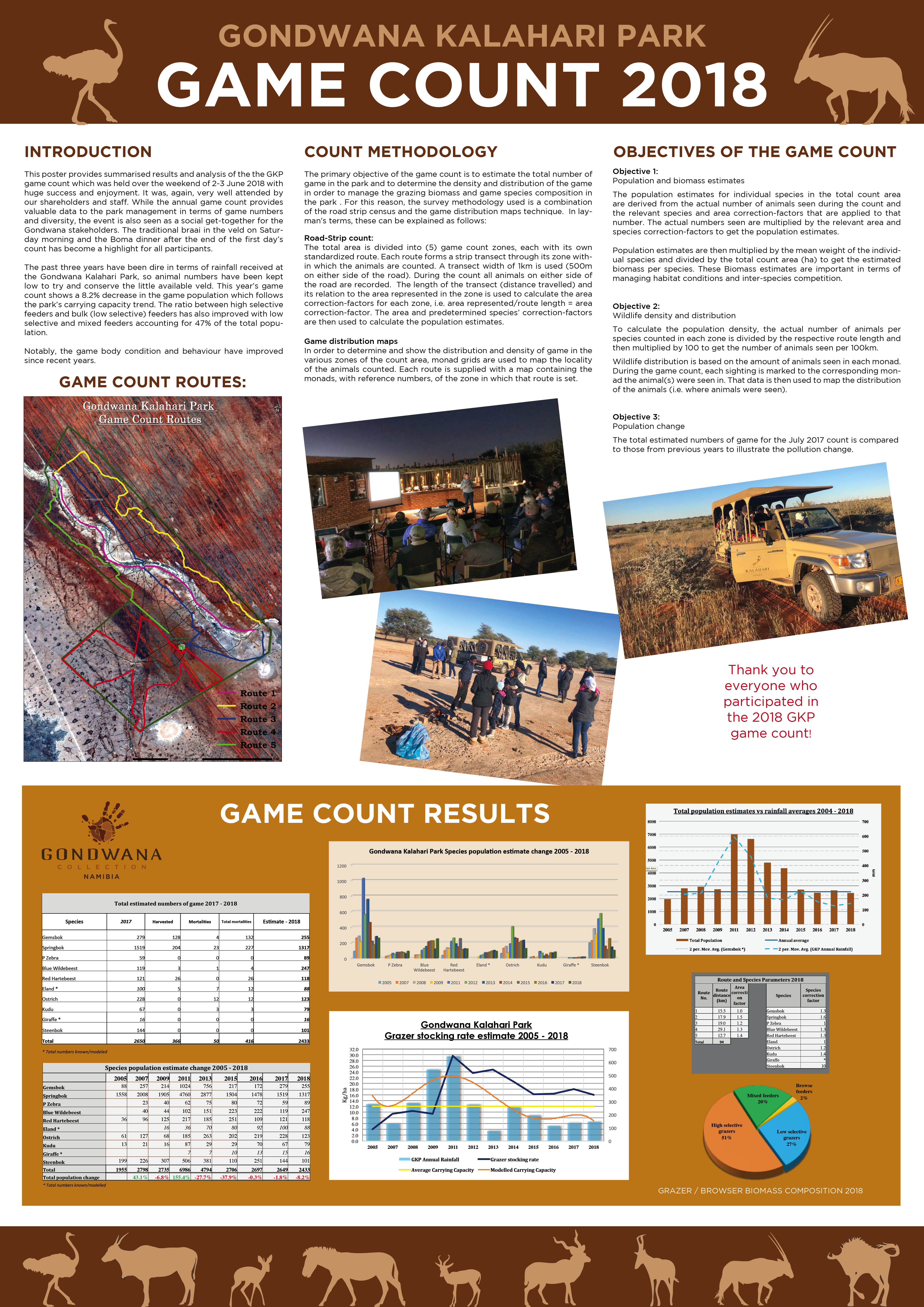
| Gondwana Kalahari Park Game Count 2018.jpg | 3.15 MB |
Summary of game counts in north-west Namibia: Hobatere concessions area, June 2017.
| Attachment | Size |
|---|---|
| Game counts in north_west Namibia_Hobatere concessions area_June 2017.pdf | 1.06 MB |
This research project deploys satellite tracking collars on ungulates in the GSNL and monitors their movements as well as other environmental parameters. Its objective is to document movement corridors and identify impediments to migration routes for springbok, oryx and Hartmann’s mountain zebra. Stefanie Urban successfully completed her Bachelor of Natural Resources Management (Honours) project at NUST at the end of 2016. Her project report is available on request.
| Attachment | Size |
|---|---|
| Tracking ungulate movements.pdf | 2.23 MB |
Vultures provide essential ecological services, yet are amongst the world's most threatened species with populations having declined by more than 95% within ten years in some places. The biggest factor causing this decline is the use of poison, either intentionally or unintentionally. Other factors causing declines are collision with and electrocution by powerlines, illegal harvesting for traditional medicines, habitat loss and drowning in reservoirs.
| Attachment | Size |
|---|---|
| Status assessment of Namibias vultures.pdf | 1.52 MB |
| Attachment | Size |
|---|---|
| Aerial count of the roan antelope and other wildlife species in Khaudum National Park_2016.pdf | 2.56 MB |
Summary of game counts in north-west Namibia: Palmwag and Etendeka concessions, June 2017.
| Attachment | Size |
|---|---|
| Game counts in north_west Namibia_Palmwag and Etendeka concessions_June 2017.pdf | 938.7 KB |
Summary of game counts in north-west Namibia: Conservancies north of the veterinary fence, June 2017.
| Attachment | Size |
|---|---|
| Game counts in north_west Namibia_Conservancies north of the veterinary fence_June 2017.pdf | 909.79 KB |
| Attachment | Size |
|---|---|
| North West Game Count data up to 2017.xlsx | 423.04 KB |
Summary of game counts in north-central Namibia, July 2017.
| Attachment | Size |
|---|---|
| Game counts in north_central Namibia_July 2017.pdf | 1.13 MB |
| Attachment | Size |
|---|---|
| South Game Count data up to 2017.xlsx | 89.28 KB |
Summary of game counts in Bwabwata NP, Dry season - Live sightings, 2017.
| Attachment | Size |
|---|---|
| Game counts in Bwabwata NP_Dry season _Live sightings_2017.pdf | 1.01 MB |
The Iona National Park covers about 15,200 km2 or 1.52 million hectares of Angola's Namibe Province in the south-western part of the country. It is the largest national park in Angola. It is bounded by the Atlantic Ocean to the west, an escarpment to the east that marks the beginning of the interior plateau, the Curoca River to the north, and the Cunene River to the south. It is about 200 kilometres south of the town of Namibe. Iona was proclaimed as a reserve in 1937 and upgraded to a national park in 1964.
Summary of game counts in north-west Namibia: Regional Summary.
| Attachment | Size |
|---|---|
| Game counts in north_west Namibia_Regional Summary_June 2017.pdf | 1.01 MB |
Summary of game counts in east Zambezi, Dry season - Live sightings, 2017.
| Attachment | Size |
|---|---|
| Game counts in east Zambezi_Dry season_Live sightings_2017.pdf | 890.83 KB |
Summary of 2017 game counts: Kavango east.
| Attachment | Size |
|---|---|
| 2017 game counts_Kavango east.pdf | 945.05 KB |
Summary of game counts in southern Namibia, May 2017.
| Attachment | Size |
|---|---|
| Game counts in southern Namibia_May 2017.pdf | 997.6 KB |
Summary of game counts in Hardap Game Park, May 2017.
| Attachment | Size |
|---|---|
| Game counts in Hardap Game Park_May 2017.pdf | 1.04 MB |
Summary of North Central Game Count data up to 2017.
| Attachment | Size |
|---|---|
| North Central Game Count data up to 2017.xlsx | 143.47 KB |
An aerial survey of elephants and other animals was conducted in North West Namibia from 16th September to 8 th October 2016. A total area of 63431km2 was sampled at an average intensity of 8.19% using both transects (at an average of 6.7% sample intensity) and block counts (9.88% sample intensity). Total counts were conducted additionally by flying 921.5km along six rivers.
| Attachment | Size |
|---|---|
| Aerial survey of elephants and other animals in north western Namibia.pdf | 8.93 MB |
Summary of game counts in north-west Namibia: Conservancies north of the veterinary fence, June 2016.
| Attachment | Size |
|---|---|
| Game counts in north_west Namibia_Conservancies north of the veterinary fence_June 2016.pdf | 855.27 KB |
| Attachment | Size |
|---|---|
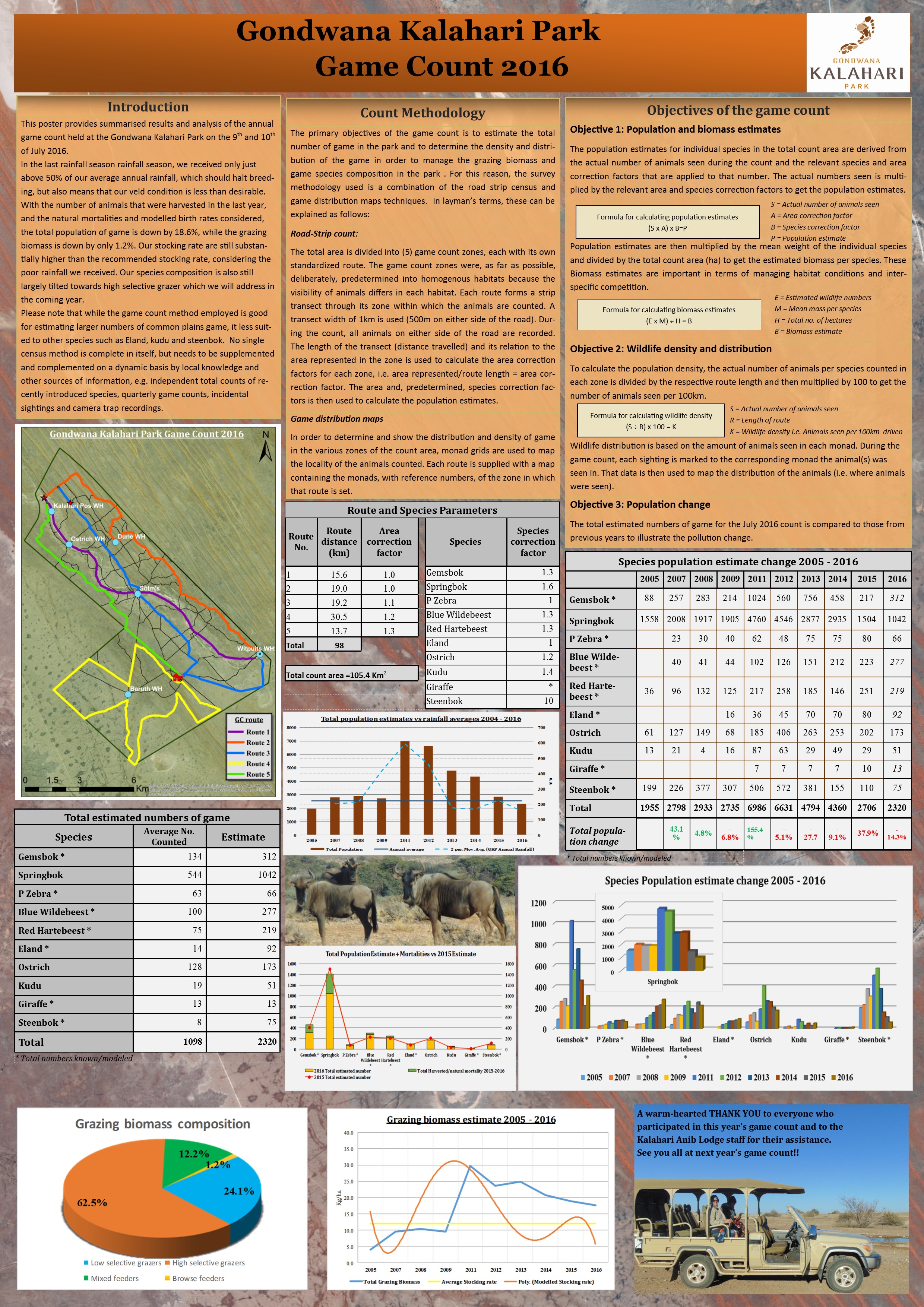
| Gondwana Kalahari Park game count 2016.jpg | 2.05 MB |
Summary of game counts in Bwabwata NP, Dry season - Live sightings, 2016.
| Attachment | Size |
|---|---|
| Game counts in Bwabwata NP_dry season_Live sightings_2016.pdf | 1.04 MB |
Summary of game counts in north-west Namibia, July 2016.
| Attachment | Size |
|---|---|
| Game counts in north_west Namibia_July 2016.pdf | 988.19 KB |
Summary of game counts in Hardap Game Park, May 2016.
| Attachment | Size |
|---|---|
| Game counts in Hardap Game Park_May 2016.pdf | 842.19 KB |
Summary of game counts in north-west Namibia: Regional Summary, June 2016.
| Attachment | Size |
|---|---|
| Game counts in north_west Namibia_Regional Summary_June 2016.pdf | 1.05 MB |
| Attachment | Size |
|---|---|
| Gondwana Canyon Park Game Count 2016.jpg | 6.98 MB |

Of the animals that had a comparable number of location pings, Oryx 1768 on Keerweder, Hartmann's zebra 1771 on Solitaire and Oryx 1770 on Aandster moved the furthest daily distances with 9.57 km, 7.87 km and 7.35 km respectively. Three animals were collared at the end of July/ beginning of August, including Springbok 132 (after the last one with the same collar id. died in March) and 133, Hartmann's zebra 1775 and 1776. Hartmann's zebra 1776, which is currently ranging on Neuras, moved a considerable mean daily distance of 9.22 km.
| Attachment | Size |
|---|---|
| GSNLNewsletter_1_3.pdf | 1.43 MB |
Summary of game counts in southern Namibia, May 2016.
| Attachment | Size |
|---|---|
| Game counts in southern Namibia_May 2016.pdf | 691.95 KB |
Oryx 1770 and Zebra 1771 covered the most distance with 921.62 km and 877.36 km respectively (assuming a straight line between each ping). Mean daily distances have overall increased since the last period, possibly due to isolated rainfall during the period. Zebra 1773 has possibly been killed or the collar fell off, this is currently under investigation. Note: The mean daily distances in the last newsletter were not correct as they were distances between each ping. They should be multiplied by three to get the mean daily distance.
| Attachment | Size |
|---|---|
| GSNL wildlife monitoring Newsletter_2_2016.pdf | 1.94 MB |