 SEARCH
 UPLOAD
 ABOUT
ABOUT CONTACT
Search results
Namibian Wildlife Surveys archive
This archive of reports of wildlife surveys in Namibia aims to:
- provide easy public access to published information and statistics
- enable easy stakeholder access to recent and historical data on wildlife populations
- provide a comprehensive archive of wildlife survey reports in Namibia
Public access to information is a vital component of ensuring community engagement in prevalent issues. Wildlife surveys are critical to determine the health of wildlife populations and determine trends over time to guide conservation and management actions.
Wildlife surveys are done for different species using methods that are suited to counting them (e.g. by air or road) in their natural habitats. Such surveys need to be repeated over time to detect long-term trends and inform conservation managers. The Namibian government, non-governmental organisations and private reserves all conduct regular surveys covering different parts of Namibia and targeting different species. This archive will thus serve as a repository of our collective knowledge of the trends and status of a variety of species occurring throughout Namibia.
Explore your search results using the filter checkboxes, or amend your search or start a new search.
Annual counts were extended to include Ai-Ais Hot Springs in 2022. Three transects were counted representing an area of around 407 km² . More years of data are required before any trends or estimates can be generated.
| Attachment | Size |
|---|---|
| Hardap Naute Ai_Ais Game Count 2022.pdf | 1009.96 KB |
The fundamental purpose of game counts in communal areas is to inform conservancies and MEFT of wildlife trends for the purposes of adaptive management of resources. While estimates of species numbers are provided, these should only be considered as an approximate guide to species abundance.
| Attachment | Size |
|---|---|
| Kavango poster 2022 final.pdf | 651.24 KB |
The fundamental purpose of game counts in communal areas is to inform conservancies and MEFT of wildlife trends for the purposes of adaptive management of resources. While estimates for some species are provided, these should only be considered an approximate guide to species abundance.
| Attachment | Size |
|---|---|
| North Central Game Count 2022_final.pdf | 767.98 KB |
The dramatic spike in the proportion of gemsbok seen in Hobatere relative to the rest of the north-west reflects the decline in animal numbers in communal conservancies. In 2021, Palmwag, Etendeka and Hobatere concessions (only 9% of the total area) accounted for 60% of all gemsbok seen in the north-west. Due to the higher number of animals seen in Orupembe conservancy in 2022 this ratio dropped to 31%.
| Attachment | Size |
|---|---|
| North West Game Count_Hobatere 2022 final.pdf | 451.43 KB |
Game counts in north-west Namibia: Conservancies north of the veterinary fence - May 2022.
| Attachment | Size |
|---|---|
| North West Game Count_North of Vet Fence 2022 final.pdf | 537.95 KB |
The Palmwag and Etendeka concession areas are important refuges for at least five of the main game species. The contrast in trends between kudu and gemsbok is noteworthy. While gemsbok numbers have declined dramatically throughout the entire north-west region, the contribution of the concessions has spiked in recent years. With kudu the contribution of concessions to numbers has dropped dramatically in the same period suggesting a different causal mechanism for the decline in numbers of the two species.
| Attachment | Size |
|---|---|
| North West Game Count_Palmwag and Etendeka 2022 final.pdf | 525.8 KB |
Wildlife populations in north-west Namibia were severely impacted in the 1980s by a combination of severe drought and poaching. Community conservation, formalised in 1996 through conservancies facilitated an increase in wildlife numbers through controlled utilisation and effective control of poaching. Between 1996 and 2012 most species experienced stable or growing population trends. However, a subsequent prolonged dry phase has resulted in a steady decline in populations of many game species. It is unclear how much illegal harvesting has contributed to this decline.
| Attachment | Size |
|---|---|
| North West Game Count_Regional 2022 final.pdf | 685.54 KB |
Game counts in north-west Namibia: Conservancies south of the veterinary fence - May 2022.
| Attachment | Size |
|---|---|
| North West Game Count_South of Vet Fence 2022 final.pdf | 560.8 KB |
Line transects were initiated in 2017 and represent almost half of the total area of the conservancy and include most of the waterholes. The area not covered by transects has low animal densities due to reduced habitat suitability and people pressure. Transect counts have recorded 25 species including 6 predator species. Based on average spoor sightings and Event Book records, hyaena are the most common predator, followed by wild dog, leopard and jackal. The top 3 species in terms of sightings between 2017 and 2022 included wildebeest, elephant and kudu.
| Attachment | Size |
|---|---|
| Nyae Nyae transect count 2022 Final.pdf | 670.9 KB |
Nyae Nyae and N#a-Jaqna Conservancies - Full moon water counts 2022.
| Attachment | Size |
|---|---|
| Nyae Nyae waterhole 2022 Final.pdf | 597.64 KB |
Game counts in southern Namibia: June 2022.
| Attachment | Size |
|---|---|
| Southern Conservancy Game Count 2022 Final.pdf | 778.48 KB |
Counts were undertaken at waterholes in the escarpment zone of north west Namibia. In 2018,18 waterholes in 7 conservancies were counted while in 2019, 2020 and 2021, the number of waterholes was increased to around 26 covering 10 conservancies. Counts were undertaken over a period of 2, 3 or 4 days during which time all animals seen were counted. Game species differ in the frequency with which they need to visit water resources with some able to acquire much of their hydration needs through foraging.
| Attachment | Size |
|---|---|
| Waterholes_NW_poster_2022_Final.pdf | 468.62 KB |
Estimates were calculated for the current year using DISTANCE. In most cases at least the last 5 years of data were used in analysis to generate a detection profile for each species. Several conservancies have been grouped due to the low numbers of animals recorded. The bottom row of the table (hyphenated) numbers = 95% Confidence Intervals. In Sikunga, very few sightings have ever been recorded (60 for all species since 2011) and no sensible estimates for any species can be derived for this area.
| Attachment | Size |
|---|---|
| Zambezi Game Count_ East 2022.pdf | 522.67 KB |
Game counts in Bwabwata N.P. - August 2022.
| Attachment | Size |
|---|---|
| Zambezi Game Count_Bwabwata 2022.pdf | 632.72 KB |
Since 2021 a boat transect has been undertaken along the Kwando river from the Angola border to the southern boundary of Mudumu National Park. The total transect length is 152 km. For each species, animals on each side of the river (and in the case of hippo, in the river,) are counted.
| Attachment | Size |
|---|---|
| Zambezi Game Count_River 2022.pdf | 377.41 KB |
| Attachment | Size |
|---|---|
| Summary of the 2015 Winter Wetland Bird Counts in Namibia.pdf | 3.06 MB |
| Attachment | Size |
|---|---|
| Wetland bird counts in Namibia_a summary_2016.pdf | 8.86 MB |
The species accounts are very detailed, doubtlessly benefitting from Peter's intimate and long-term knowledge of Botswana's birds. The range maps give one an immediate indication of where the bird occurs and the breeding bars give one an idea of when to expect the bird and when it breeds. These will prove handy when identifying e.g. migratory birds. The excellent illustrations show the birds in their local race and where sexes and ages differ, these are also illustrated. Perhaps one shortcoming of the illustrations is, that diagnostic features e.g.
| Attachment | Size |
|---|---|
| Book Review_Birds of Botswana.pdf | 346.34 KB |
The Nile crocodile,Crocodylus niloticus, is found throughout sub-Saharan Africa, including Namibia, Botswana and Angola. The species was transferred from CITES Appendix I to Appendix II in 2004, although it is recognized as peripherally endangered in Namibia due to diminishing habitat availability primarily from human encroachment. In 2013, a species management plan was approved in Namibia to assess the management of the Namibian Nile crocodile populations. During 2012, an aerial survey was conducted to provide an estimate of Nile crocodile population numbers.
Summary of game counts in north-west Namibia: Regional Summary, June 2016.
| Attachment | Size |
|---|---|
| Game counts in north_west Namibia_Regional Summary_June 2016.pdf | 1.05 MB |
Summary of game counts in north-west Namibia, July 2016.
| Attachment | Size |
|---|---|
| Game counts in north_west Namibia_July 2016.pdf | 988.19 KB |
Summary of game counts in north-west Namibia: Conservancies north of the veterinary fence, June 2016.
| Attachment | Size |
|---|---|
| Game counts in north_west Namibia_Conservancies north of the veterinary fence_June 2016.pdf | 855.27 KB |
Summary of game counts in north-west Namibia: Conservancies south of the veterinary fence, June 2016.
| Attachment | Size |
|---|---|
| Game counts in north_west Namibia_Conservancies south of the veterinary fence_June 2016.pdf | 893.65 KB |
Summary of game counts in north-west Namibia: Palmwag and Etendeka concessions, June 2016.
| Attachment | Size |
|---|---|
| Game counts in north_west Namibia_Palmwag and Etendeka concessions_June 2016.pdf | 906.75 KB |
Summary of game counts in north-west Namibia: Hobatere concessions area, June 2016.
| Attachment | Size |
|---|---|
| Game counts in north_west Namibia_Hobatere concessions area_June 2016.pdf | 794.73 KB |
Summary of game counts in southern Namibia, May 2016.
| Attachment | Size |
|---|---|
| Game counts in southern Namibia_May 2016.pdf | 691.95 KB |
Summary of game counts in Hardap Game Park, May 2016.
| Attachment | Size |
|---|---|
| Game counts in Hardap Game Park_May 2016.pdf | 842.19 KB |
Summary of game counts in Bwabwata NP, Dry season - Live sightings, 2016.
| Attachment | Size |
|---|---|
| Game counts in Bwabwata NP_dry season_Live sightings_2016.pdf | 1.04 MB |
After the initial and in-depth assessment of the leopard population in the Okonjima Nature Reserve via the use of remote camera traps that provided a detailed insight of their demography as well as temporal and spatial distribution patterns, a long-term monitoring program has been introduced. This aims to observe and monitor fluctuations in the composition of the population, as well as shifts and overlaps of home ranges and territories.
| Attachment | Size |
|---|---|
| The assessment of leopard density and population size via a capture.pdf | 1.45 MB |
An aerial survey of elephants and other animals was conducted in North West Namibia from 16th September to 8 th October 2016. A total area of 63431km2 was sampled at an average intensity of 8.19% using both transects (at an average of 6.7% sample intensity) and block counts (9.88% sample intensity). Total counts were conducted additionally by flying 921.5km along six rivers.
| Attachment | Size |
|---|---|
| Aerial survey of elephants and other animals in north western Namibia.pdf | 8.93 MB |
| Attachment | Size |
|---|---|
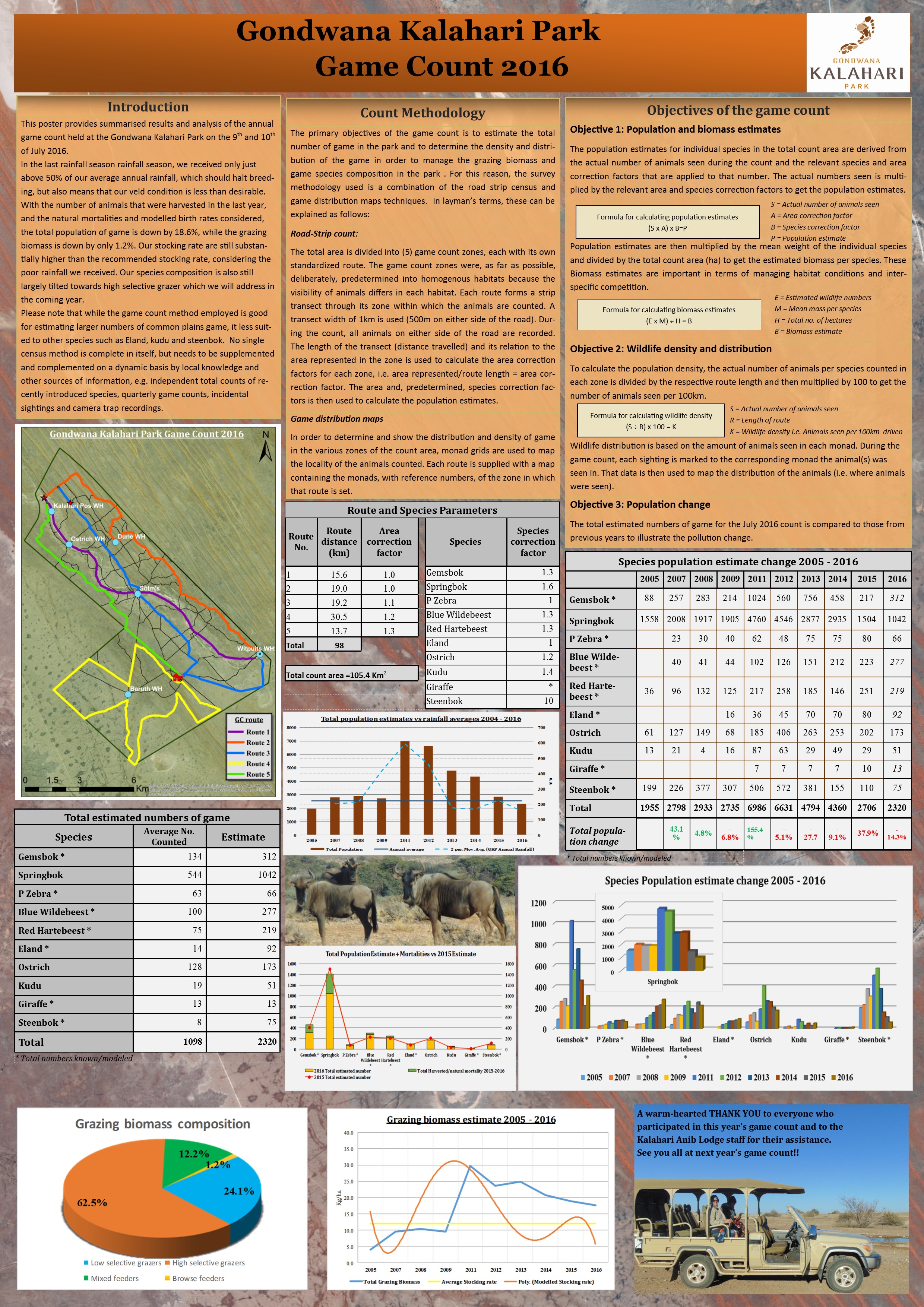
| Gondwana Kalahari Park Game Count 2016.jpg | 5.56 MB |

| Attachment | Size |
|---|---|
| Gondwana Canyon Park Game Count 2016.jpg | 6.98 MB |

| Attachment | Size |
|---|---|
| Gondwana Kalahari Park game count 2016.jpg | 2.05 MB |
| Attachment | Size |
|---|---|
| GSNL wildlife monitoring Newsletter_2016.pdf | 2.92 MB |
Oryx 1770 and Zebra 1771 covered the most distance with 921.62 km and 877.36 km respectively (assuming a straight line between each ping). Mean daily distances have overall increased since the last period, possibly due to isolated rainfall during the period. Zebra 1773 has possibly been killed or the collar fell off, this is currently under investigation. Note: The mean daily distances in the last newsletter were not correct as they were distances between each ping. They should be multiplied by three to get the mean daily distance.
| Attachment | Size |
|---|---|
| GSNL wildlife monitoring Newsletter_2_2016.pdf | 1.94 MB |
Of the animals that had a comparable number of location pings, Oryx 1768 on Keerweder, Hartmann's zebra 1771 on Solitaire and Oryx 1770 on Aandster moved the furthest daily distances with 9.57 km, 7.87 km and 7.35 km respectively. Three animals were collared at the end of July/ beginning of August, including Springbok 132 (after the last one with the same collar id. died in March) and 133, Hartmann's zebra 1775 and 1776. Hartmann's zebra 1776, which is currently ranging on Neuras, moved a considerable mean daily distance of 9.22 km.
| Attachment | Size |
|---|---|
| GSNLNewsletter_1_3.pdf | 1.43 MB |
African elephants (Loxodonta africana) are imperiled by poaching and habitat loss. Despite global attention to the plight of elephants, their population sizes and trends are uncertain or unknown over much of Africa. To conserve this iconic species, conservationists need timely, accurate data on elephant populations. Here, we report the results of the Great Elephant Census (GEC), the first continent-wide, standardized survey of African savannah elephants. We also provide the first quantitative model of elephant population trends across Africa.
| Attachment | Size |
|---|---|
| Continent_wide survey reveals massive decline in African savannah elephants.pdf | 392.74 KB |
Areas surveyed: The Okavango River in Namibia, from just northwest the bridge on the Trans-Caprivi highway south to the Botswana border; the entire length of the Kwandu-Linyanti-Lake Liambezi-Chobe system, including the Mamili National Park; and the Zambezi river for its entire length on Namibia's border, including parts of the adjacent East Caprivi floodplains.
| Attachment | Size |
|---|---|
| Wattled Crane Survey_2004.pdf | 1.02 MB |
This study has provided baseline data on crocodile numbers from aerial and spotlight counts. These data can be used with the results of future counts to determine population trends. The census has also provided information on their distribution of crocodiles in the Kavango and Caprivi regions. And third, it has resulted in the first population estimate for crocodiles in the north-east wetlands of Namibia.
| Attachment | Size |
|---|---|
| Crocodile Survey in NE Namibia_2004.pdf | 404.87 KB |
Human and, increasingly, elephant pressure on Namibia's wetlands and riparian belts are a major cause of conservation concern. Many wetland birds are listed in Namibia's Red Data Book (Simmons & Brown in prep) because of population declines caused by the degradation and destruction of wetland habitats, and because of high levels of disturbance. Good information on the status of major wetlands and their avifauna is important for their conservation management. Birds provide one of the best indicators of wetland health.
| Attachment | Size |
|---|---|
| Kwandu wetland and floodplain Bird counts Aug 2004.pdf | 349.12 KB |
Namibia is one of few African countries that support six species of large carnivore. Lions, leopards, cheetahs, spotted hyaenas, brown hyaenas and wild dogs occur primarily in the northern and western sections of Namibia. With the possible exception of lions and leopards we have a poor understanding of the exact distribution and density of these species, although available information suggests that the populations are stable. The Namibia Large Carnivore Atlas was launched to involve the tourism industry and the Namibian public in collecting baseline data on the six large…
| Attachment | Size |
|---|---|
| Namibia Large Carnivore Atlas_July 2004.pdf | 770.46 KB |
Namibia is one of few African countries that support six species of large carnivore. Lions, leopards, cheetahs, spotted hyaenas, brown hyaenas and wild dogs occur primarily in the northern and western sections of Namibia. With the possible exception of lions and leopards we have a poor understanding of the exact distribution and density of these species, although available information suggests that the populations are stable. The Namibia Large Carnivore Atlas was launched to involve the tourism industry and the Namibian public in collecting baseline data on the six large…
| Attachment | Size |
|---|---|
| Namibia Large Carnivore Atlas_12_2003.pdf | 1.29 MB |
Summary of game count in north west in 2004: route statistics, animals seen, population estimates, trends.
| Attachment | Size |
|---|---|
| NW game count poster 2004.pdf | 483.95 KB |
Namibia is one of few African countries that support six species of large carnivore. Lions, leopards, cheetahs, spotted hyaenas, brown hyaenas and wild dogs occur primarily in the northern and western sections of Namibia. With the possible exception of lions and leopards we have a poor understanding of the exact distribution and density of these species, although available information suggests that the populations are stable.
| Attachment | Size |
|---|---|
| 2004 Game Count in Gondwana Canon Park.pdf | 1.11 MB |
An aerial wildlife survey of the Nyae Nyae Conservancy in Namibia was conducted between 27 August and 5 September 2004. Using stratified systematic transect sampling techniques the 8,900km2 area was samfled at an average intensity of 33 %, during 54 hours of flying. The survey produced population estimates with relatively narrow confidence intervals for some of the abundant species, like kudu, gemsbok and ostrich. Wildlife numbers, as a whole, appeared to have increased when compared with the previous survey in 1998. An abbreviated summary of the numbers of wildlife is listed…
| Attachment | Size |
|---|---|
| Aerial survey of wildlife in the Nyae Nyae Conservancy_Namibia_September 2004.pdf | 3.33 MB |
The conflict between lions and pastoralists bordering Etosha National Park is a well known and documented problem. Every year lions move beyond the borders of Etosha National Park (Etosha) and prey on domestic livestock. In protection of their livestock, pastoralists shoot, trap, or poison lions. Data on these lion mortalities have been collected since 1982. Many individuals, including staff of the Ministry of Environment and Tourism, and visiting researchers, have collected these data.